


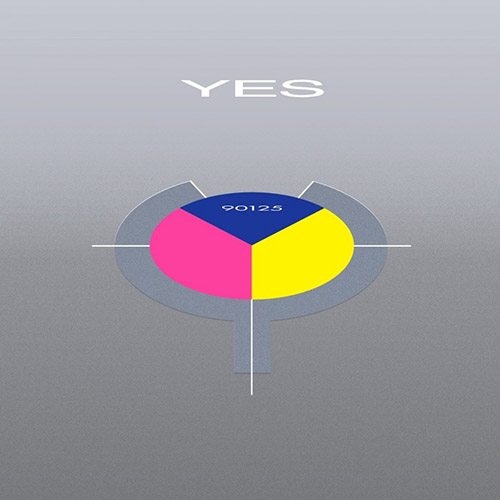
The album was titled after its Atco Records catalogue number (for example, 7-90125-1 for the LP).
Personnel

Vocals

Keyboards

Guitars, Vocals

Bass, Vocals

Percussion
Recommended Versions
Dan Hersch & Bill Inglot 2003 Stereo Remasters for Warner Music UK/USA
Available as:
HD 24-192, 24-96 or 24-44.1 Downloads at HD Tracks, HiRes Audio
Gatefold CD at Amazon
Vinyl LP as per original release (no extra tracks) at Amazon
MP3 Downloads at iTunes (Standard Edition, Mastered for iTunes), iTunes (Deluxe Edition), Google Play, 7 Digital, Microsoft Store
Streaming at Apple Music, Spotify, Rdio, Tidal

The Box Set contains the following remastered albums with bonus tracks: Yes, Time and a Word, The Yes Album, Fragile, Close to the Edge, Tales from Topographic Oceans, Relayer, Going for the One, Tormato, Drama, 90125, Big Generator. Each individual album comes in a gatefold sleeve that replicates the original LP packaging.
Isao Kikuchi 2013 Stereo Remasters for Warner Music Japan

High Vibration is a 16 x Hybrid SACD Box Set made for the Japanese fans, containing their first 13 albums on 15 discs plus a bonus disc of extra tracks. All Remastered by Isao Kikuchi at 24-96 & 16-44.1 with a 220 page book in Japanese.
Albums: Yes, Time and a Word, The Yes Album, Fragile, Close to the Edge, Yessongs, Tales from Topographic Oceans, Relayer, Going for the One, Tormato, Drama, 90125, Big Generator and a Bonus Disc.
Bonus Disc: Something’s Coming, Dear Father, Roundabout (Single Edit), America, Total Mass Retain (Single Version), Soon (Single Edit), Abilene, Run Through The Light (Single Version), Run With The Fox, Owner Of A Lonely Heart (Move Yourself Mix), Leave It (Single Remix), Big Generator (Remix).
Listen
Spotify
Dan Hersch & Bill Inglot 2003 Stereo Remasters90125 - by Brian Ives
It was more than a YES “reunion.” It was YES, reimagined. A contemporary band for the ’80s, not a band relying on a legion of dedicated fans and a hefty catalog of great songs (although they certainly had both). This YES could appeal to a new audience, unfamiliar – or even uninterested – in past glories. 90125 made YES as much of the ’80s as The Yes Album, Fragile and Close To The Edge were of the previous decade. But it almost didn’t happen; in fact, this YES was actually a brand-new group.
But let’s rewind a bit: YES came to an end after a 1980 tour with a revamped lineup, one that didn’t include original singer Jon Anderson. Founding bassist Chris Squire along with longtime guitarist Steve Howe and drummer Alan White had hooked up with The Buggles, aka singer Trevor Horn and keyboardist Geoff Downes, to release one album under the YES moniker, Drama (1980). This incarnation hit the road, but something wasn’t clicking, and all involved called it a day. Horn went on to form ZTT Records and pursue a career as a producer, while Howe and Downes formed the supergroup Asia (with former King Crimson bassist/singer John Welton and ex-ELP drummer Carl Palmer).
Chris Squire and Alan White stuck together, contemplating a supergroup of their own with Jimmy Page, then fresh from Led Zeppelin. That didn’t work out, although depending on who you ask – some of the ideas from those sessions would later be used in Page’s next supergroup, The Firm, which also featured ex-Free and Bad Company frontman Paul Rodgers.
Trevor Rabin had a long musical history. Born in South Africa, he was an in-demand session musician by his teens, and by his twenties he was fronting Rabbit, which rocked up platinum album sales and sold-out stadium concerts. When the band split up Rabin moved to England to go it alone. After a couple of solo albums, he moved to L.A. for a change of scene. When Chris Squire heard demos for his new songs at the offices of Atlantic Records, he contacted the South African musician. Rabin got on well with the Yesmen, and the band Cinema was born.

Rabin was a multitalented performer; he could sing as well as play guitar and keyboards. But his load would be lessened after Squire bumped into Tony Kaye at a social gathering. Tony Kaye was YES‘ founding keyboardist, but he left the band in 1971 due to management and creative differences. Replaced by Rick Wakeman, Kaye promptly formed the band Badger and released One Live Badger (1973), followed by White Lady (1974), recorded with New Orleans R&B legend Allen Toussiant.
In addition, Kaye played keyboards in sessions for the group Flash, which featured original YES guitarist Peter Banks. He’d also served as keyboardist in a late-’70s Badfinger reunion and supported David Bowie on his Station To Station tour. Kaye, who’d never played alongside drummer Alan White (who’d replaced Bill Bruford in 1972, after Kaye was gone), was soon invited to join the Cinema ranks, bringing the number of ex-Yesmen to three.
Cinema, now a four-piece featuring Squire, White, and Kaye, plus Rabin on guitar and lead vocals, were now ready to start work on their debut. Perhaps surprisingly, they hired another ex-YES member, Trevor Horn, to produce the record. As the sessions progressed Cinema decided that they needed a frontman, as the music they were playing was fairly complex, and Rabin wasn’t sure he wanted to have to worry about singing and playing guitar live. Eventually, Chris played some of Cinema‘s music for Jon Anderson, who liked what he heard. Chris asked Jon to sing on it. The rest is history; Jon was back in the fold, and Cinema became the eighth version of YES.
Rabin had doubts about the move, at first. When he initially hooked up with Squire and White, it was a new project, with unknown expectations. Now, as YES, they’d have to deal with the long shadow cast by the band’s prior work. But the move turned out well for everybody. In retrospect, Rabin’s entrance is no more or less a radical lineup or sound change than Howe’s band debut in 1971, replacing founding guitarist Peter Banks. Rick Wakeman and Alan White had also changed the group dynamic and sound when they joined (in Wakeman’s case, each time he joined); YES has always been about incorporating the skills and influences of new musicians into the collective.
Still, 90125 (so named for the album’s selection number in the Atlantic Records catalog) was a departure for YES in more ways than one, featuring tightly written rock songs and contemporary production values. Even the cover sleeve was telling: in place of the iconic Roger Dean – created YES logo and the usual lush, sprawling Dean landscapes was a design featuring then-current computer graphics. The word YES was displayed in ordinary typeface! But the album still retained the musicianship the group had always been known for. And most of the faithful bought 90125, albeit with slight reservations.

In pop culture terms a “comeback” often refers to an artist who has been away and literally “comes back,” or returns to recording and/or touring. Or it might apply to an artist who returns to his former glory after a period of disappointment. So while 90125 is often referred to as YES‘ “comeback” album, only the former definition works here. Commercially it eclipsed anything YES had done before and brought them to new heights of popularity.
“Owner Of A Lonely Heart” (one of the songs on Rabin’s demo tape that caught Trevor Horn’s attention) gave the band their first (and, as of this writing, only) #1 Pop single. A disturbing video, which seemed a bit out of character for YES at the time, made them MTV fixtures. Like fellow veterans Genesis, ZZ Top, and The Kinks, the imaginative use of this innovative visual forum gave YES a new lease on life and a younger, enthusiastic fanbase. And thanks to some remixes, the song also put YES, rather improbably, on the dance music and R&B charts. “Leave It” and “It Can Happen” enjoyed pop success (also thanks to MTV). Meanwhile, “Hold On” and “Changes” were played on rock radio and became in-concert favorites. “Cinema,” a nod to YES Mark 8’s intended moniker, won YES their first (and only) Grammy®, for Best Rock Instrumental Performance.
90125 accomplished one of the rarest of feats in contemporary pop music by pulling in a new audience for a band with more than a decade of history. But like Aerosmith’s Permanent Vacation and the Grateful Dead’s In The Dark (both of which reintroduced older groups to the MTV generation), it also drew something of a line in the sand, inspiring much debate among the faithful for years to come.

But a few facts cannot be denied: without Trevor Rabin, the band probably wouldn’t have reunited. He provided Squire, White, Anderson, and Kaye with an artistic shot in the arm. YES‘ venture into the pop arena would make their later return to sprawling mini-epics all the more eagerly anticipated and exciting. Both of the above points provide good reasons why the Trevor Rabin era, which officially starts here, was healthy for YES.
Which brings us to another undeniable point: 90125 is a great record, from start to finish. So sit back, and with open ears, listen to the sound of a vital band being reborn.
– Brian Ives