

YES – The Stone Eagles and the Time and a Word Album Cover
by David Watkinson
Let me start by saying that the stone eagles are nothing to do with the gaming industry in which they are sometimes depicted, and it’s also not some trendy rock band from the 1990s. What I am going to talk about though, oddly enough, are beautifully modelled 19th century pairs of garden statuary eagles that are synonymously linked to a classic
Think back to the 1970s and the controversial album cover Time and a Word. Most

The UK Album Cover

The Italian Album Cover

The grand eagles, architectural pillars, and pediment of the album cover. (Atlantic)
Less controversially, the covers of the same album released in the USA, Germany, Russia, Italy, and Hungary (including reissues) were released with different designs.
Steve Howe was added to the cover, replacing the nude lady for the USA edition, and yes with some controversy, as he didn’t play on it. The Russian version still had the lady, but colourised, unsure if that made it better or worse, and then there was the German and Italian editions with Yes in a photo session, at the Fulham Architectural Centre in London. The image taken by David Gahr, shows the fascinating detail of a salvage yard, with Yes casually posing among the stonework, readying themselves to take on the music world with that all important, second album. Some editions didn’t have the wording written across the pediment.

The U.S. album cover

The German album cover
The German version of the album cover showed those very prominent and memorable large stone carved birds (Eagles) on each side of the pediment, it recently occurred to me that there may be a story around them.
Having recently walked down the Kings Road in London (to pick up a rare poster), I came across what I believe to be those large stone eagles on a very fancy building. Could these be the YES TAAW cover eagles? The similarity of the birds found on a building which is situated so close to the original salvage site meant I had to investigate, obviously!
These eagles currently reside on a pizza restaurant on the Kings Road. On investigation, this buildings history is remarkable. It has housed an upholsterer, a general store, a dance school, a club, a home for the maker of dolls’ house furniture for Queen Mary, and the portrait painter for the Queen Elizabeth II. It is quite an extraordinary place with a crazy history that it deserves to be written about.
Now home to The Pizza Express, The Pheasantry, 152/154 King’s Rd, London, SW3 4UT. Its links to the music and arts scene have always been strong. In a previous incarnation, it was home to Eric Clapton of Cream, has seen visitors such as George Harrison, Queen (who played there in their very early days), Thin Lizzy, Sparks, Hawkwind, and Lou Reed, who all graced the small stage.
The establishment for dandies, drunks, the magazine OZ, artists, writers, and major film stars of the 50s such as Humphrey Bogart and Lauren Bacall. It was a dance academy, run by the famous Madam Seraphina Astafievas, who taught Dame Margot Fonteyn. Richard Burton, Anthony Hopkins, Peter Cook and Dudley Moore all hung out there, it was one of the coolest places to be seen at.
A slightly unsuccessful naughty movie (‘The Party’s Over’) was filmed there with Oliver Reed as lead actor. John Barry provided the score but removed his name from all advertising once the British Board of Film Classification reviewed it, saying, it was “unpleasant, tasteless and rather offensive”.
YES played the small Pheasantry stage on the 17 October 1968. This was one of the very few YES gigs that featured Tony O’Reilly on drums, because Bill Bruford went off to University in Leeds. No image of that line-up live yet, but we can hope one day it will come.

The article above, published just after the Pheasantry Yes show, taken from the magazine Disc and Music Echo on the 19 October 1969, confirms Tony as the drummer. (Geoffrey Mason)
One of the few books to document the venue, was by a current jazz singer called Joanna Strand, who wrote the book The Pheasantry – The Untold Story. A story she tells well; I am thankful for her work here. Live in concert she performs the song ‘America’ in her shows, so strangely enough, we have yet another YES link.
The official web site for the grandest pizza restaurant in London gives us nothing much to go on, so I had to resort to the web for more, which cites that, The Pheasantry, is a Grade II listed building that was home to several important figures in the 1960s London, and a small music venue in the 1970s where bands were able to play their first gigs. Adding that ‘The Pheasantry is an historic Georgian building originally used to raise pheasants for the royal household.’
Back to YES then, could these eagles on the Pheasantry be linked to the TAAW cover ones? By the end of 1969 the Pheasantry was in a poor state of repair, neglected by owners so much so, that it was felt to be unfit to save and was readied for demolition, many parts were damaged, having been neglected for so long. The buildings either side were knocked down and all the Pheasantry building was removed, apart from the frontage and the archway. Statues were damaged by the demolition work but due to its significance and local standing, the neighbourhood fought hard and long to save as much as possible. Parts would have been needed for replacement and so it is possible replacements came from the architectural salvage site nearby. Part of the locals’ journey to keep it looking as it has always done, was to tell the legendary stories of the goings-on in there by artists and patrons, making a stronger case for its survival.

The Atlantic Records album eagle version

The image taken when it was readied for demolition in the late 1960s.
We know that it was not in a good state in 1969, but with the residents having won the journey to save it, the restoration work carried on for a good few years. This was fronted and driven by Sir John Betjeman along with the Friends of The Pheasantry, who wanted it to reflect its artistic past by incorporating an art gallery, and exhibition space. Although they were not completely successful some of the old parts survived the demolition – the frontage, gateway, and walls (even though these were heavily restored).
Looking at dates for the TAAW YES cover salvage eagles, the David Gahr YES photographs were taken in July 1969, at 120 Fulham Palace Road, where YES had a day out taking press photos across the Fulham area. This photoshoot included the empty shop front and zebra crossing (Abbey Road anyone?) and the garage forecourt with fuel (gas) pumps around them.
The old corresponding dated images of the Pheasantry in 1969 show the dereliction of the building was in at that time, which was to get much worse as it was gutted.
“If architecture is frozen music, the Pheasantry in Kings Road, Chelsea must be the ‘Ride of the Valkyries’. The great black stone horses tearing on the portico look as if they are about to start up their jet engines and carry the building shuddering into the shy. And sure the villainous beaky birds that flank the walls are Sinbad-type rocs, not silly pheasants.”
The words of Bevis Miller, taken from the Harpers Magazine, 1969 (NMP publishing)
Even in this state and worse, the venue retained a vibe, it was that place where something special had happened and if only it could be revived, then it would be the place to hang out again and restore a shining jewel for the arts. Yes, it had seen just about every bohemian type there, enjoying life to the full, smoking, dancing, singing, chatting, and drinking, but there was the feeling that at all costs it must not be lost to the area. One reviewer said of the place…
“’The Pheasantry’: what a profanely insipid name for this perverted palace, which might be a chapel of Beelzebub, Aleister Crowley’s pied-á-terre, a créche for Rosemary’s baby or a finishing school for vampires.”
The words of Bevis Miller, taken from the Harpers Magazine, 1969 (NMP publishing)

a newspaper article reporting the damage to the horses, and the general goings-on with the builders and its long story to being rebuilt. (NMP publishing)

The Pheasantry in a poor state. (NMP publishing)

A 2022 image showing a smaller eagle still there and many other features (David Watkinson)

The image of the eagles from a Japanese magazine. (Shoji Yamada).

The colourful enhanced non-Atlantic Russian cover. (Russian Disc)

A 2022 image of the left-hand eagle that is very similar to the TAAW eagles. (David Watkinson)
What is surprising is just how much architectural material the frontage of the Pheasantry still has, from the large twin eagles either side of the entrance, to the decorative railings, the gas lamps, and the plaques on the walls. It still looks like the Fulham architectural centre of 1969 even now, in 2022.


Could they be the replacement eagles from just down the road? The distance between the two sites is only 3.3 miles. The architectural site was extremely convenient and as the site was large, locals would have known about it. The visual similarities to both sites in 1969 are amazing. The famous maker of such eagles Austin and Seeley, originally started their business in 1828, having acquired the moulds from a company which went out of business. Their factory was established in New Road in the east side of London, where he was trading as an Architect, Statuary Mason, Sculptor, and an artificial stone maker. Eagles that are similar in design to the album cover eagles are on the entrance garden wall in Washington Old Hall, birthplace of George Washington in Washington village in the Northeast of England.

Another photo from the Fulham photo shoot in 1969, which has on the left-hand corner of a much larger image, another bird sculpture. From the contact sheet C218, shown in 2022 on Ebay. (David Gahr).
The eagle sizes look to be in proportion and the design is the same, the colour is similar, and we know they have been around for many decades. On the building they were painted gold at some point, and at another later time the whole frontage had a crazy over-paint of garish out of character bright colours, along with a restaurant name change. The locals were horrified by the sight of it. This design and colour palette was strongly challenged, and then, having been forced by the local community and council, it was changed back to its splendour, and back to being The Pheasantry.
The truth is then, I can’t be 100% sure that the Pheasantry eagles are the YES Time and a Word cover eagles, or whether damaged ones were replaced by those shown on the album cover photo, but if – as a YES fan – you think they may be worth looking at, and wondering, what if, then do take in the restaurant and music venue too.
While you are there, try to picture YES walking down the Kings Road in the 1960s. Tony Kaye lived close by and of course the cover photos for the Peter Banks’ early YES music release, Beyond And Before – The BBC Recordings 1969-1970 album, were taken outside the house at 42 Munster Road, Fulham. Look at 50A Munster Road, where YES lived, and also where Robert Fripp and Keith Emerson would pop round for a drink or two with mates. Meander down the road to take a look at where King Crimson were born at 193 Fulham Palace Road or hunt down 871 – 875 Fulham Road where YES had a photo shoot at a filling station (garage) called Tanner Bros, who’s owner lived next door to YES on Munster Road. These just a few of the West London Yes sites to visit, some of which were on the YES 50th Anniversary bus tour in 2018.

The classic album cover taken in Fulham. (Get Back Records)
Inspired by the eagles in the story, I decided to investigate YES history looking for bird links and found the following:- Love Will Find a Way, we see a big bird in the opening scene, with the band shown by a fire, the scene set in a plane hangar. Owner of a Lonely Heart, we have Jon turning into a bird of prey and in Rhythm of Love, we see a mini robotic bird. The YES Fly From Here album cover by Roger Dean has a few on the sleeve also, maybe there has been a long-time YES connection with our feathered friends, and all these are relevant to the story, or maybe not, perhaps it’s just a bit frivolous and fun.
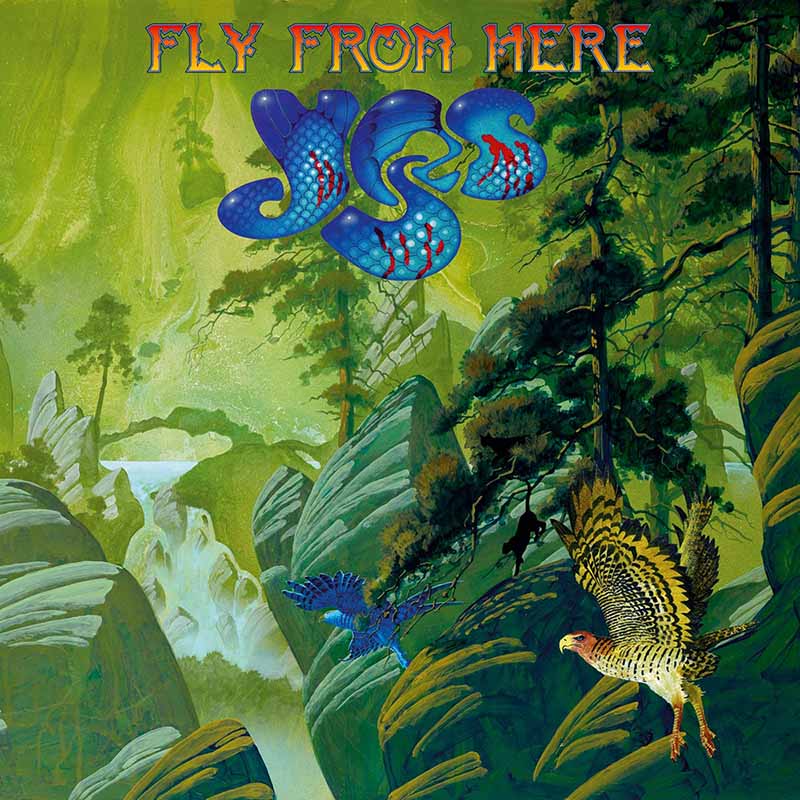
The Yes album Fly From Here cover by Roger Dean. (Frontiers Records)

The Yes video Love Will Find A Way opening bird scene. (Atlantic)

Jon Anderson turning into an eagle in the Owner Of A Lonely Heart video. (QEDG)
As you can see, a lot of the fascinating early YES history was around West London, so whether it is the eagle topped restaurant and its amazing history you wish to view, or some famous YES site photo opportunity, at the above-named places, why don’t you go and have a venture out sometime soon. Maybe you will see ‘the eagle in the sky’.
– David Watkinson
Click here to read more of David’s articles & essays on YEShistory.